
Market Update
Zambia's new competitive procurement framework turns solar ambition into bankable pipeline
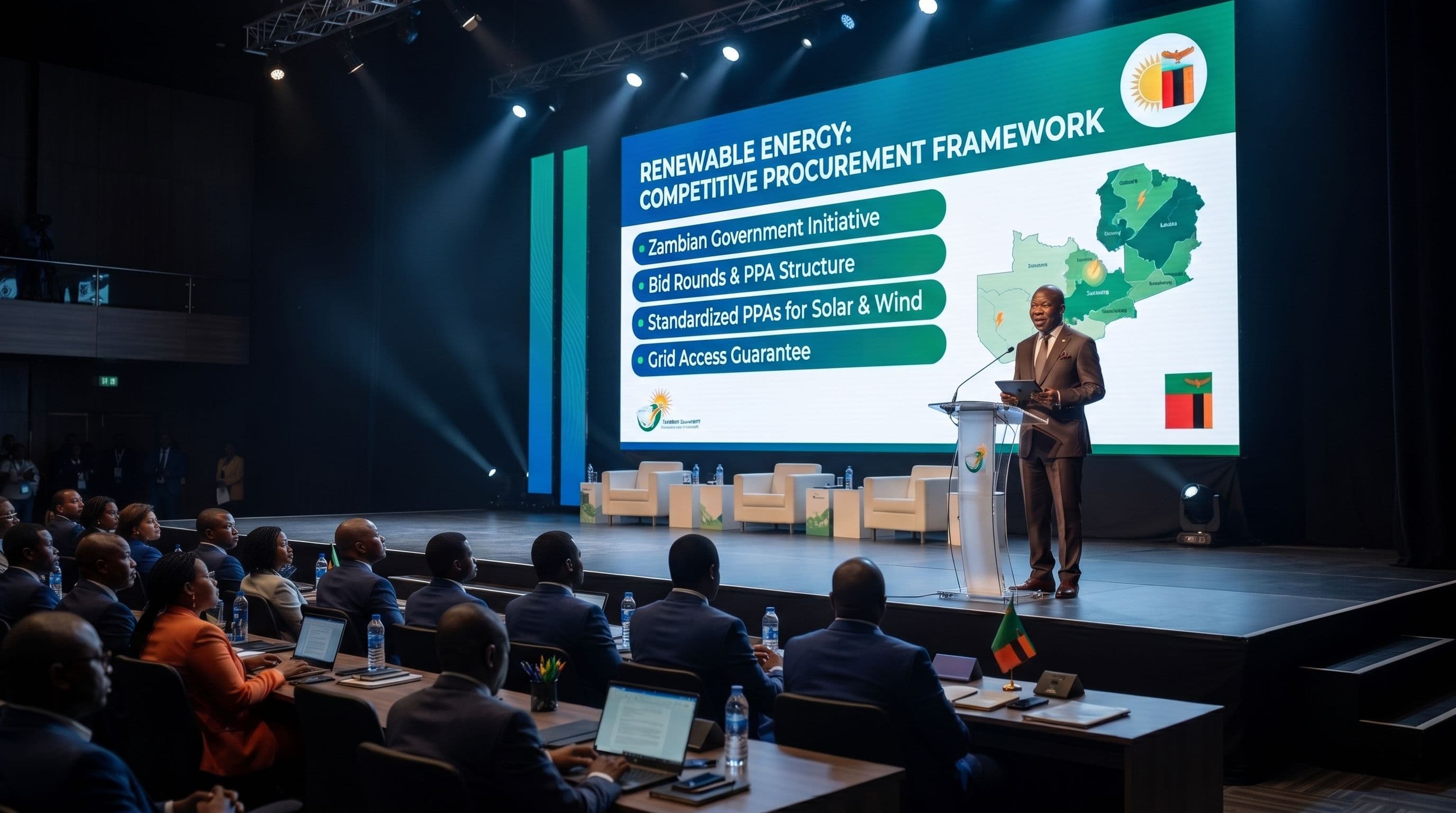
Zambia has spent the last two years learning an expensive lesson about concentration risk. With hydropower supplying more than 80% of the national grid, the 2023–2024 drought cut hydro output by roughly half and pushed peak load-shedding to 8–10 hours a day. In May 2026, the Ministry of Energy responded with the piece of market architecture the sector has been waiting for: a Competitive Procurement Framework that finally gives large-scale renewable projects a repeatable, bankable route to market.
The framework matters less for its ambition than for its structure. It introduces REIPPPP-style bidding windows (a first round targeted before year-end, with a further programme running 2027–2030), a Renewable Energy Liquidity Mechanism (RELM) to buffer offtake payment risk, and a Norway-backed Carbon Feed-in Programme offering a ten-year premium. Alongside it, a 300 MW solar tender under the Carbon Finance Procurement Facility signals real deal flow rather than policy signalling. These instruments speak directly to the three questions every lender asks: who pays, what happens if they don't, and for how long is the revenue certain.
That is the crux. Zambia already has roughly 1.15 GW of solar operational and another 1.64 GW under construction — the appetite is not in doubt. What has constrained financial close is bankability: single-buyer exposure to a utility under balance-sheet strain, and the absence of credit-enhancement structures international funders can underwrite against. RELM and the carbon premium are precisely the kind of mechanisms that move a project from "developable" to "financeable."
For developers and equity partners, the framework rewards those who structure early and structure well. A competitive bid window compresses tariffs and leaves little room for projects carrying unpriced regulatory, grid-connection or offtake risk into the final stretch. The winners will be the projects where legal structuring, energy-yield modelling and the financing case were aligned from origination — not retrofitted before submission.
This is the environment Imvelo is built for. Our four advisory pillars — financial and transaction advisory, technical and engineering due diligence, legal and structuring, and institutional capacity building — are sequenced to close out exactly the risks Zambia's new framework asks bidders to price. As the first window approaches, the advantage sits with teams that treat bankability as a design principle from day one.
Zambia's message to the market is clear: the door to competitive renewable procurement is open. The question is who arrives with a project already structured to walk through it.